Donner Hush I Evo 2 Review: This Tiny Travel Guitar Sounds Far Better Than It Should
The Donner Hush I Evo 2 is tiny, quiet and ridiculously convenient — but does it actually sound good? We put this silent travel guitar through its paces.

Travel guitars have traditionally involved some degree of compromise. They’re either small but slightly awkward, convenient but uninspiring, or technically portable while still occupying enough luggage space to make you question whether bringing a guitar was really such a good idea. The Donner Hush I Evo 2 takes a rather more extreme approach: remove almost everything that doesn’t absolutely need to be there.
The result is tiny. Properly tiny. Unplugged, it’s also about as loud as a typical electric guitar, which is rather the point. The Hush I Evo 2 is essentially a silent acoustic designed to be plugged in for practice, recording or live performance, with a headphone output for those occasions where even electric-guitar levels of acoustic noise are too much.
I’ve always enjoyed Donner’s Hush guitars, partly because I’m quite a large human and the size disparity is objectively funny, but there’s a genuinely clever instrument hiding behind the comedy. The original Hush I had plenty of promise but also a few things that bothered me, and the Evo 2 addresses those criticisms while remaining considerably simpler than the more feature-heavy Hush I Pro.
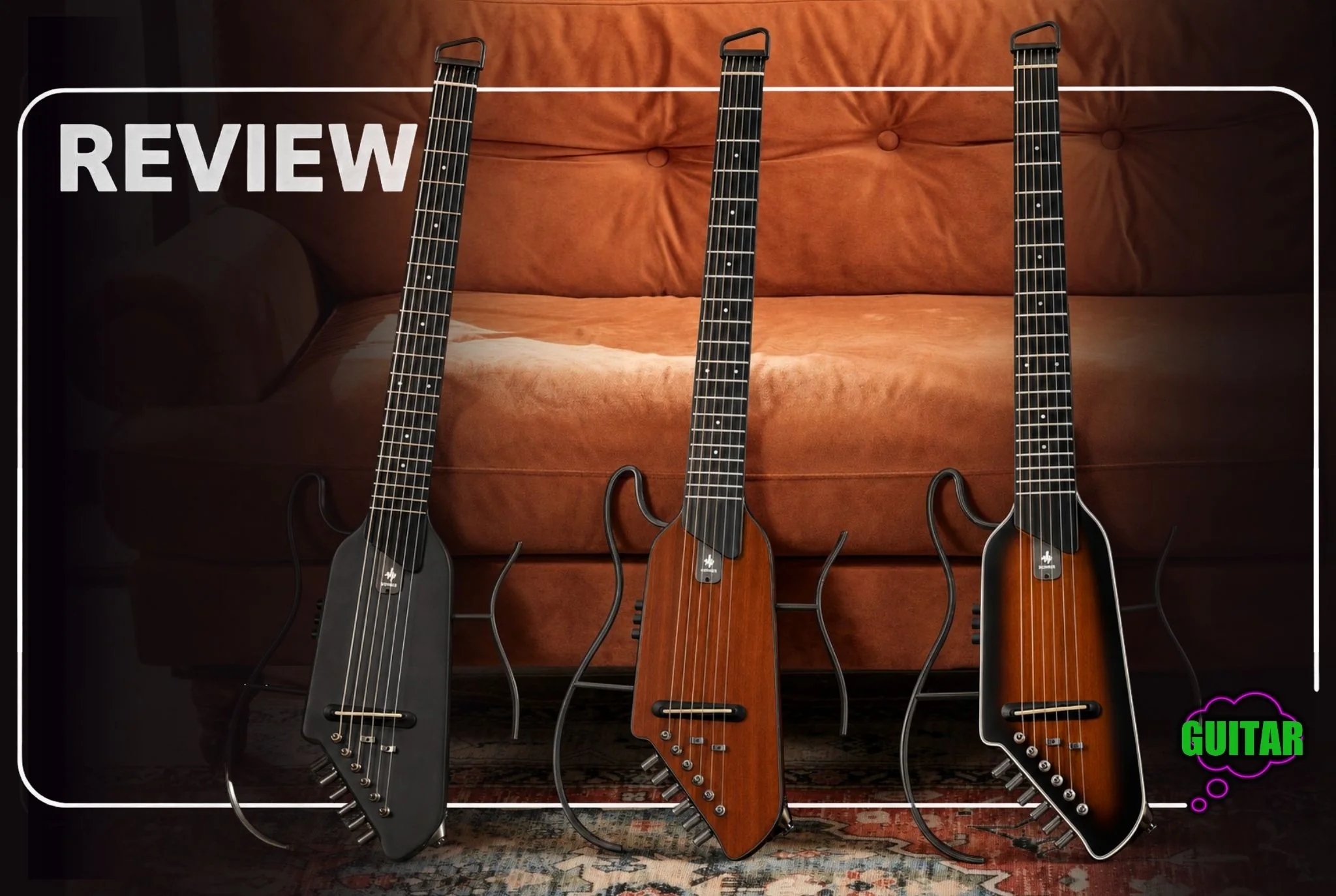
Much of the cleverness is in the physical design. It’s a headless, neck-through, entirely solid-wood instrument with no sound-producing chambers, and with the detachable body wings removed it does bear more than a passing resemblance to a cricket bat. On a strap, that doesn’t matter in the slightest. If you’re sitting down, the supplied wings screw into place in seconds and create a sort of modern-art outline of a conventional guitar body. They’re rock solid once attached and come straight back off when it’s time to put the guitar away.
The lack of a headstock inevitably makes conventional hangers and stands a bit useless, so Donner has put a small hanger at the top of the guitar instead. It’s the sort of practical little detail that makes you realise somebody has actually thought about how this thing is going to be used rather than simply making a guitar very small and calling it a day.
The neck is equally well considered. There’s a five-piece construction visible beneath the dark finish on the rear, and because it’s neck-through there’s no heel to get in your way at the top end. The HPL fretboard is relatively flat, though not classical-guitar flat, with rounded fret edges and medium-jumbo frets giving it a distinctly modern feel.
You get 20 frets, which is perfectly sensible. Personally, I’d take another couple because I enjoy disappearing into the dusty end when I probably shouldn’t, but for the vast majority of what anybody is going to play on a guitar like this, 20 is plenty.
The asymmetric neck profile is particularly comfortable, carrying a little more mass on the treble side before slimming down towards the bass side. It’s a fairly slender carve overall and works very nicely for modern acoustic styles without feeling insubstantial.
The really important upgrade, though, is the HPS2 pickup system. On a conventional acoustic, the plugged-in tone is only half the story. On a guitar that’s basically silent without amplification, it’s the story, and Donner has made a significant improvement here.
For some perspective, I put the Evo 2 up against one of my favourite full-size acoustics, a Cort Flow OC fitted with an LR Baggs pickup system. The Cort is way, way, way more expensive, considerably bigger, louder and more cumbersome, and naturally it’s going to sound much more impressive acoustically in the room. Plug them both in, though, and the Donner gets surprisingly close. It punches well above its weight, and its tiny dimensions actually make for a very comfortable playing experience.
The electronics are refreshingly straightforward. There’s volume, centre-notched bass and treble controls with plenty of boost and cut, and holding the volume control brings up a clear onboard tuner. Two eighth-inch connections cover headphone practice and external audio, meaning you can feed backing tracks or a metronome from your phone straight into the guitar.
Donner even includes a set of in-ear monitors, and they’re actually quite nice. That means you can use the silent-practice side of the guitar immediately rather than opening the box and discovering that one of its headline features requires another purchase.
At the opposite end of the guitar sit six open-geared tuners, as is traditional with headless designs. Some earlier Hush guitars I’ve played had tuners that were annoyingly difficult to turn, but these feel much more positive. There’s a small hex wrench magnetically attached to the body if they ever do become stiff, and the same tool can be used to snug up the screws holding the body wings in place.
Another issue with some of the earliest Hush models was the lack of setup adjustment, but that’s been remedied for some time with an adjustable truss rod. I didn’t need it here. The Evo 2 played great straight out of the box, with no action adjustment required.
The bundle is unusually complete too: gig bag, strap, cable, in-ear monitors, rubber tips for the body wings and even some bundled plectrums that, against all expectations for free plectrums, are actually rather good. For a beginner, there’s very little else required, and for travelling players it’s essentially ready to throw in the car or luggage and go.
That’s probably how I’d use one. I have acoustic rehearsals where, frankly, I’d rather take this than haul a full-size acoustic around purely for convenience, and I’d have no issue using it in a professional setting. It’s small enough that keeping one handy for an impromptu jam actually makes sense.
Would I buy the Evo 2? Personally, I’d go for the Hush I Pro instead. The Pro adds a more fully featured preamp with body models, reverbs and various other things to fiddle with, and I am, regrettably, exactly the sort of person who enjoys fiddling with things.
If you’re not afflicted by that particular gearhound tendency, the simpler Evo 2 arguably makes more sense. It gives you excellent playability, a genuinely impressive plugged-in sound and all of the convenience that makes the Hush concept so appealing without burying any of it beneath unnecessary features.
It looks rather good too. The sunburst finish, dark rear and three-ply binding give the skeletal design considerably more character than you might expect from something built primarily around portability.
The Hush I Evo 2 takes what was already a smart idea and fixes the things that held the earlier versions back. It’s tiny, plays beautifully, comes with practically everything you need and sounds far better plugged in than its dimensions have any business suggesting. For practice, travel, rehearsals or even professional use, Donner has turned the silent travel guitar into something you might choose to play rather than merely tolerate for the sake of convenience.
Find out more about the Donner Hush I Evo 2 at DonnerMusic.com