Fishman Fluence P90 Classics Review: More Muscle, Less Hum
With three voices, noiseless operation and plenty of high-end clarity, these modern P90s from the good folks at Fishman promise the best of both worlds. But can it really match the feel of a great passive P90?

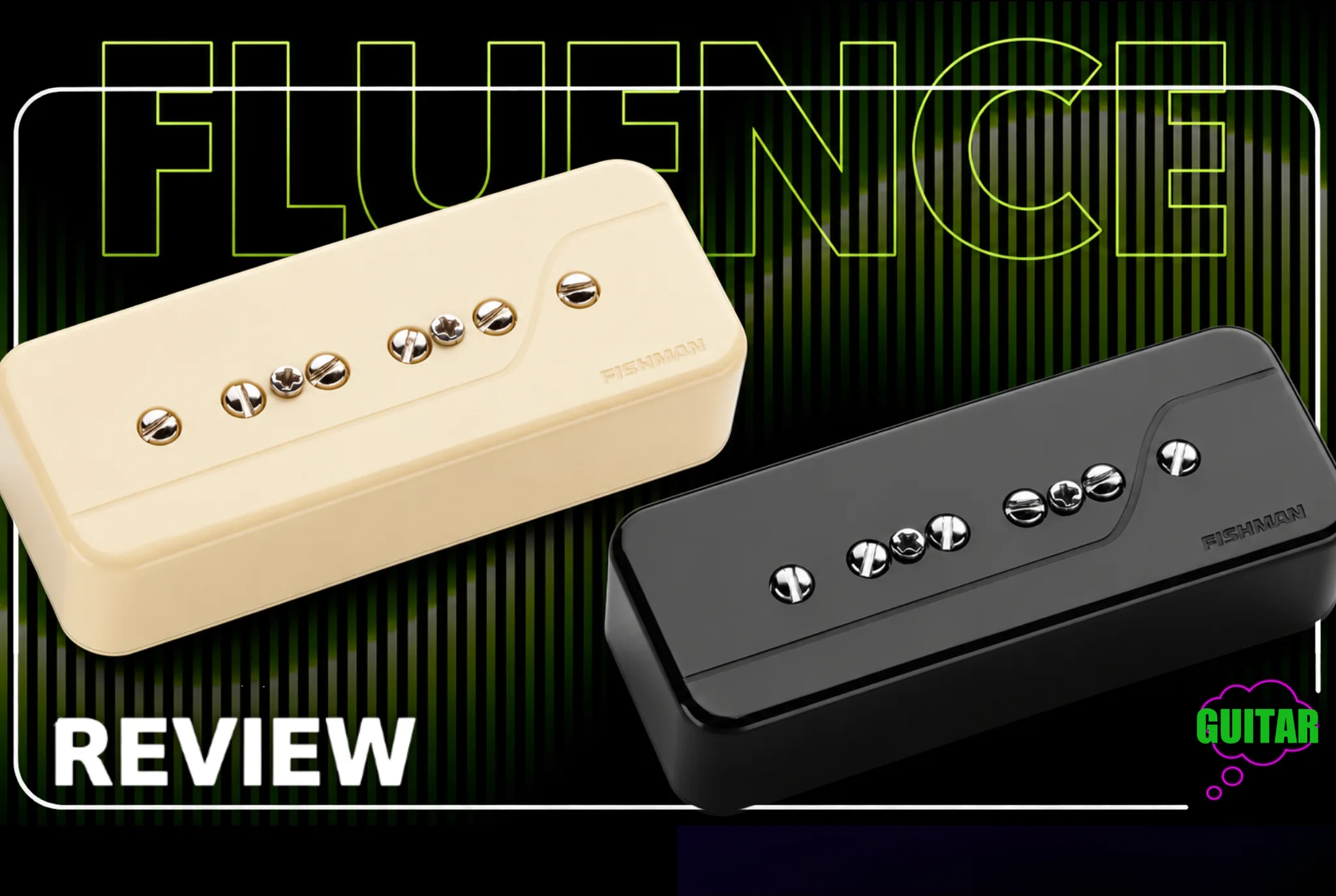
Take the unmistakable bark and bite of a P90, remove the noise, add three switchable voices and somehow stop the hot setting from turning into a wall of midrange mush, and you’ve basically got the Fishman Fluence P90 Classics. Using Fishman’s printed-coil Fluence technology, these powered pickups offer vintage and hot P90 voices alongside an F-style single-coil sound, all while promising the consistency and flexibility that have become the calling card of the Fluence range.
P90s, for the unfamiliar, are wonderfully simple things. Magnets, coils, plenty of attitude, job done. Fishman hasn’t completely rewritten that rulebook here — there are still magnets and coils involved — but instead of winding wire around a bobbin in the traditional way, the Fluence Classics use printed coils. For us gearhounds, that opens up some genuinely useful possibilities.
For starters, Fishman can make the pickups exceptionally consistent from one unit to the next. Their low-impedance design also makes them happier driving long signal runs and gives the volume and tone controls a much more linear response. Useful stuff, certainly, but the real party trick is that each pickup contains three separate voices.
Voice one is your vintage, underwound-style P90 sound. Voice two turns up the heat, adding more low end and midrange push, while voice three heads into F-style single-coil territory — think somewhere between a Strat and a Tele. Even here, the bridge and neck aren’t simply copies of one another: the bridge gets a bright, jangly single-coil voice, while the neck is designed to be clear and airy.
Things get particularly clever when you move into the hotter P90 sounds. Anyone who has spent time messing around with P90s knows the problem. Wind them hotter and, yes, you get more output, more mids and more low-end shove, but the top end tends to disappear along the way. It’s the eternal P90 trade-off: more muscle, less sparkle.
The Fluence Classics essentially cheat. On the neck pickup, the hotter voice adds that extra push without dumping the high end, while the bridge moves from a vintage P90 voice into a properly screaming lead sound. You get the power you’d expect from something more heavily wound, but without making everything sound like someone has thrown a blanket over your amp.
For comparison, the Fishmans were put up against a set of passive Bulldog P90s with an underwound neck measuring around 5.6k and an overwound bridge at roughly 8.2k. They were also compared with Fishman’s Greg Koch signature Fluence P90s, with all three voices tested through clean, JCM800-style and lead tones.
This is also where the old-school passive pickups manage to fight back.
A good passive P90 is ridiculously dynamic, and the Fluence Classics don’t feel quite the same under the fingers. There’s a little more compression and a slightly more modern response here. They’re not squashed in the way you might associate with traditional high-output active pickups, and plenty of that classic P90 character remains, but if you live for that completely raw interaction between pick attack and amplifier, you’ll feel the difference.
What you get in exchange is fully noiseless operation, which, given that we’re talking about P90s, is a pretty substantial win. Fluence pickups also tend to be bright because there’s nothing in the circuit rolling off those highs, and that becomes especially useful when you start piling on more output.
The hardware side is nicely thought out too. Push connectors make the pickups easy to disconnect or swap, and the package includes an output jack, battery clip, replacement 25k pots and push-pull controls for switching voices. The only thing you don’t get is a pickup selector because your guitar’s existing switch handles that job.
Being powered pickups, they need 9V, either from a normal battery or one of Fishman’s rechargeable lithium-ion packs. Those offer somewhere around 200 hours of playing time and can be charged in roughly 15 minutes. Very handy. Less handy is the Micro USB connection rather than USB-C. To borrow the sentiment from the review itself: come on, lads. It’s time.
The set tested here contains a bridge and neck pickup, although individual pickups can apparently be bought separately. They’re available in black or cream, and Fishman also offers versions for guitars fitted with dog-ear P90s.
Compared with the Greg Koch signature set, the Classics are smoother, more open and less aggressive, while the Koch hot voices have more of that raunchy, midrange-forward thing going on. Which one works better is really going to come down to what you want from the guitar.
The Fluence P90 Classics aren’t passive P90 killers, and they don’t need to be. Traditional P90s still have that wonderfully immediate, hyper-dynamic feel, but the Fishmans answer back with three genuinely useful voices, completely noiseless operation and hot sounds that don’t throw away the treble in pursuit of more power. If you’re a P90 fan who wants considerably more flexibility without abandoning what makes the format great in the first place, there’s an awful lot to like here.
Find out more about the Fishman Fluence P90 Classics at Fishman.com