N-Audio 8×7 Amp Switcher Review: Eight Amps, Seven Cabs and Zero Cable-Swapping Headaches
The N-Audio 8×7 Amp Switcher puts eight amps and seven cabs at your fingertips, with MIDI control, clever safety features and far less cable-swapping chaos.

There are worse problems to have than owning too many great guitar amps, but once you’ve accumulated enough of them, actually using the things becomes surprisingly inconvenient. You’ve got the amp you use every day, the amp you swear you’ll use on the next project, the one that does that particular mid-gain thing brilliantly, and the one you bought because obviously you needed another flavour of high gain. Then you look at the speaker cables, decide you can’t be bothered, and plug into the same head again.
This is exactly the problem the N-Audio 8×7 Amp Switcher is designed to solve.
Nick Jennison’s studio setup is a fairly extreme test case. He has a PRS Archon, Victory Super Kraken, Super Jack, Super Sheriff, Copper and Duchess, along with a 20-watt Marshall JCM800 Studio Classic and a 20-watt Super Lead Studio Vintage. Before the 8×7 arrived, the Super Kraken was doing most of the work simply because recabling everything else was a pain. With the N-Audio in place, all eight amplifiers can stay permanently connected and ready to go.
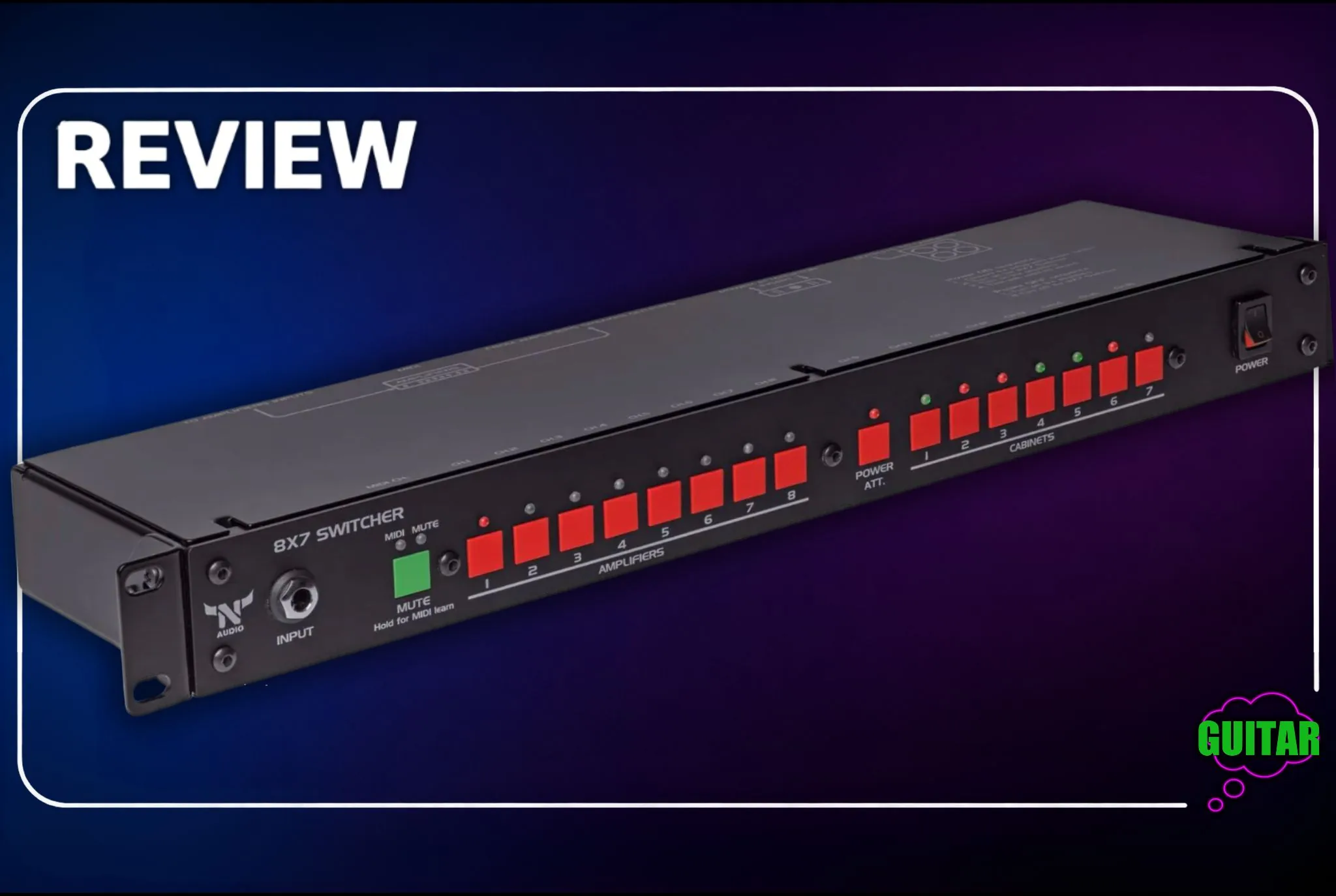
For the unfamiliar, the 8×7 is essentially command central for a frankly irresponsible number of amplifiers. It can accommodate up to eight amps and seven cabinets, with as many as three cabinets active at once. There’s also provision for a power attenuator, and the whole thing can be controlled manually or via MIDI.
That last part is where it starts getting properly nerdy.
Jennison has his running from a Boss ES-8 alongside a Voodoo Lab Control Switcher, giving him roughly 20 presets covering the amp channels he actually uses. They’re split broadly into clean, Marshall-flavoured mid-gain and high-gain sounds, with his preferred Super Jack and Super Kraken lead tones available regardless of which bank he happens to be in. Effects can be folded into those presets too, so changing from one complete rig sound to another becomes a single footswitch operation rather than a small engineering project.
Of course, sending the output of eight valve amplifiers around electronically has the potential to become very expensive indeed if something goes wrong, and this is where N-Audio has been particularly clever.
The switcher won’t let you select an amplifier until a connected cabinet has been chosen, and outputs with no cabinet attached simply aren’t available to select. Any amplifier that isn’t currently active is automatically connected to a permanent resistive load, so it’s never left running into nothing. You can even use the system with an attenuator and no cabinet attached, but the 8×7 deliberately makes you go through a series of checks before allowing it.
In other words, you have to try fairly hard to do something catastrophically stupid.
There’s plenty going on around the back too: eight sends to the amplifier inputs, eight returns from their speaker outputs, seven cabinet outputs, MIDI in and out, a tuner output and a send/return for the attenuator. Guitar inputs are provided front and rear, so the studio can stay permanently wired into the back while the front remains available when you want to plug straight in.
N-Audio has also gone with a regular IEC mains connection rather than an external barrel-style supply. This sounds spectacularly boring until you consider that it keeps the switcher properly grounded and means a dead or missing mains lead can be replaced with something you probably already own several of. Not glamorous, but very sensible.
The signal path itself is completely analogue and true bypass, with relay switching and no internal buffer. This caused a brief moment of panic when Jennison first wired everything up and discovered that a decent amount of his high end appeared to have vanished.
The culprit wasn’t the switcher.
He’d effectively created something in the region of a 60-foot unbuffered guitar cable by running through the pedalboard, into the N-Audio and then out across another lengthy cable run to the amps. Once the buffer was switched back on, the tone returned to normal immediately.
Personally, I’d rather have it this way. A built-in buffer would force every signal through it whether you wanted one or not, whereas the N-Audio leaves that decision to you. If your cable runs are sensible, carry on. If your studio wiring looks like the back of Abbey Road, put a buffer in front of it.
One unexpected benefit is just how useful the 8×7 becomes for comparing amps. Guitarists have notoriously strong opinions about tiny tonal differences, but our audio memory is also hilariously short. Being able to jump almost instantly between a Super Sheriff, Super Jack and Marshall Studio Vintage through the same cabinet and signal chain makes those differences much easier to hear. The low-end response, midrange character and general feel of each amp become obvious in a way they simply aren’t when there are five minutes of crawling around behind cabinets between them.
There is one unavoidable downside: you’re going to need cables. Lots of cables.
Jennison used at least eight guitar cables and eight long speaker cables before even counting the additional connections required elsewhere in the rig. Wiring and labelling the whole thing took a little over an hour and 15 minutes. The good news is that this is very much a suffer-once arrangement; after the initial setup, everything can essentially be left alone.
Jennison is also upfront about the fact that he received a very good deal on the two switchers he owns after meeting N-Audio’s Nikki at Guitar Summit. The review itself wasn’t sponsored or part of that arrangement, and his enthusiasm is pretty easy to understand once you see what the unit has done to his workflow.
The N-Audio 8×7 isn’t going to make your amplifiers sound better, add another channel or magically improve your playing. What it does is remove virtually all of the friction involved in owning a large amp collection.
If you have one head and one cabinet, this is absurd.
If you have eight amps and regularly find yourself ignoring seven of them because changing over is too much hassle, it starts looking absolutely brilliant.
And for the committed gearhound, there might be no greater luxury than having every ridiculous amp you own permanently wired, completely safe and only one button press away.
Find out more about the N-Audio 8×7 Amp Switcher at N-Audio.net