
VHT VT20M Review: Digital Flexibility Meets a Proper Valve Power Section
The VHT VT20M mixes digital modelling with a proper 20-watt 6V6 valve power section. Great cleans, clever features and a few genuinely odd choices.

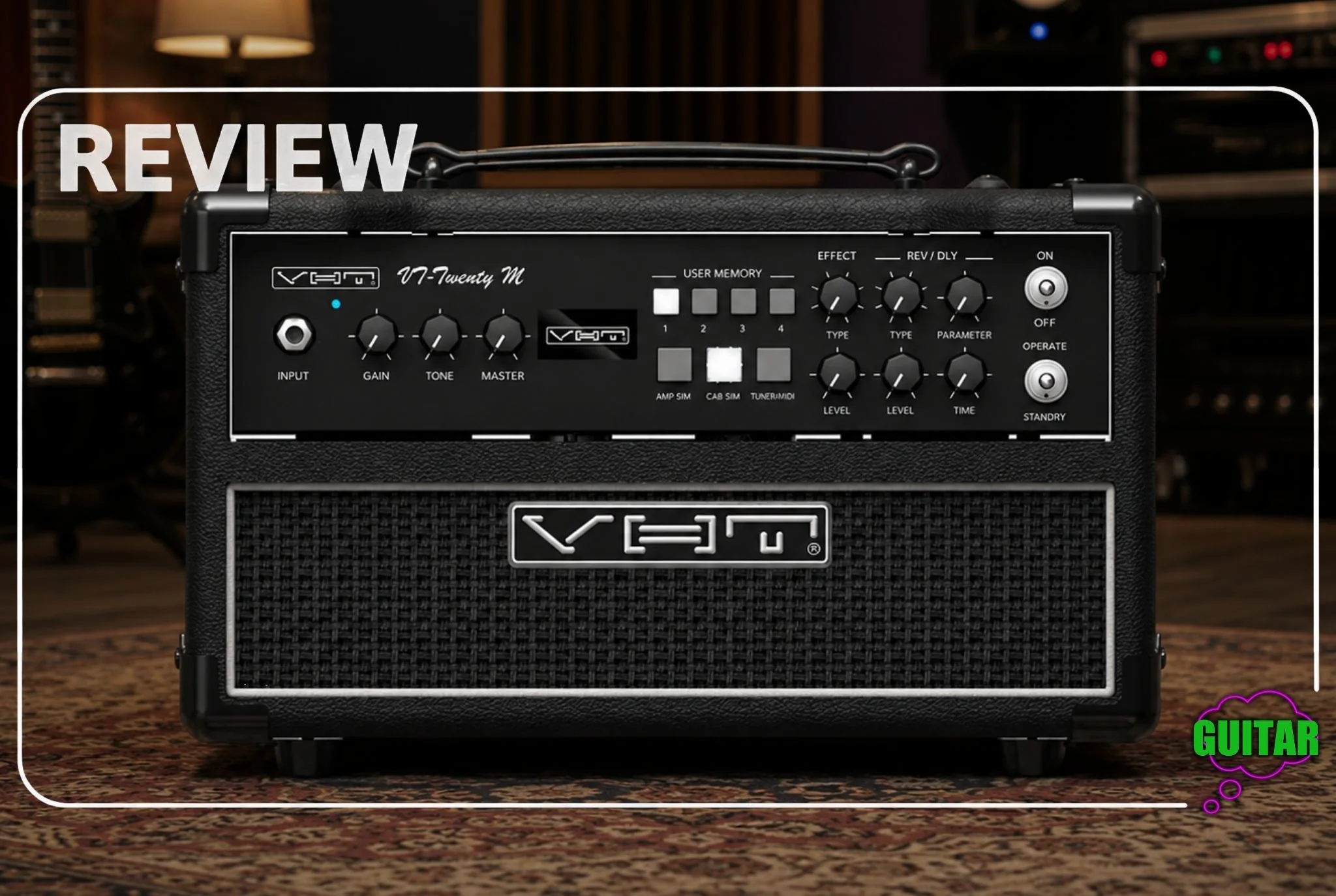
“Hybrid amp” is one of those phrases that will mean very different things depending on how long you’ve been playing guitar. For younger players, it probably sounds like a perfectly sensible combination of digital and analogue tech. For those of us who remember the less glamorous examples from years gone by, it may conjure images of solid-state amps with a solitary 12AX7 stuffed into the preamp so the word “valve” could make it onto the front panel.
The VHT VT20M, thankfully, does the whole thing the other way around.
Here, the preamp is digital, giving you a collection of amp models, modulation effects, delays, reverbs and cabinet simulations, while the power section is a proper 20-watt valve affair with a pair of 6V6s and an output transformer. In other words, all the convenient modern stuff happens up front, while the bit actually driving your speaker is reassuringly old-school.
Sonically, the VT20M knows where its strengths lie. The clean and lower-to-mid-gain sounds are really good, and the two Tube models are among the most natural tones in the amp. The crunch setting is great too, and if your world revolves around cleaner playing, classic styles or hitting an amp with pedals, there’s plenty here to work with.
Things get a little shakier once you start piling on the gain. The heavier models become more compressed and noticeably sizzlier, and the Distortion model has a particularly distinctive thing going on. To my ears, it’s not a million miles away from a Boss DS-1 running into a clean amplifier. That’s certainly a sound, and there will absolutely be someone out there who loves it, but if your idea of a good time involves crushing modern high gain, this probably isn’t the amp I’d point you towards.
The good news is that operating the thing is refreshingly painless. There’s no sprawling control panel or endless menu diving: gain, tone and master take care of the basic amp settings, with the tone control effectively handling overall brightness. You don’t get individual bass, middle and treble controls, which sounds restrictive on paper, but the models are voiced well enough that I never found myself desperately reaching for a missing EQ knob.
There’s a large screen showing your current amp, cab and effects choices, plus four user-saveable presets. The factory sounds are a little enthusiastic when it comes to modulation, so I’d probably skip through those fairly quickly and start making my own. Once you do, the ability to footswitch between presets makes the VT20M much more useful on stage than you might expect from what could easily have been positioned as a practice amp.
You also get tap tempo, with a long press turning the same switch into a tuner. Simple, useful and exactly the sort of feature you’ll appreciate when you realise you don’t need to find your clip-on tuner for the fifteenth time that week.
The effects are another pleasant surprise. The modulation options are perfectly respectable, but the reverbs and delays are the standouts. They sound good enough that the effects section feels like a genuinely useful part of the amp rather than something added so VHT could put another bullet point on the box.
Then we get to the cab sims, and this is where things become a bit weird.
There’s an XLR output around the back that takes its feed from the preamp rather than the 6V6 power section. That means you can put the amplifier into standby and still get signal from the XLR, which is excellent for silent recording. The cab simulations themselves can sound very good direct too, although—as with most collections of cab sims—some are better than others.
The strange bit is that switching one on also sends that cabinet simulation through the speaker output. So if you’re already plugged into a real guitar cab, you’re now listening to a simulated guitar cabinet through another guitar cabinet.
Cabception, if you will.
Unsurprisingly, it isn’t ideal. It also means that if you’re using the XLR and a real cab at the same time, you can realistically only optimise one of them. I’d much rather have seen the cab simulation restricted to the XLR while leaving the speaker output untouched.
Thankfully, VHT redeems itself with what might be the cleverest feature on the whole amp: Amp In.
The VT20M doesn’t have a conventional effects send and return, but Amp In lets you bypass the digital preamp completely and plug straight into the 6V6 power section. If you already own a modeler or a dedicated preamp pedal, you can therefore use the VT20M as a compact 20-watt valve power amp.
There is a small compromise. Because the XLR output is connected to the VT20M’s own preamp, you lose access to it when using Amp In. With most modern modelers and preamp pedals offering their own direct outputs—and with miking a real cab still very much an option—that’s hardly disastrous.
Amp In also makes the VT20M surprisingly appealing for stereo rigs. Take the effects send from your main amplifier into a stereo delay or reverb, feed one side back into your main amp and the other into the VHT, and suddenly you’ve got two valve power sections running in stereo without having to buy another expensive full-size head.
The VT20M is undoubtedly a mixed bag in places. Its higher-gain tones aren’t its finest hour, and whoever decided the cab sims needed to appear at the speaker outputs as well as the XLR made a choice I’m not entirely convinced by. But the sounds it does well are very good indeed, the effects are surprisingly impressive and the 20-watt 6V6 power section gives it uses well beyond its built-in modelling.
For a newer player, there’s enough variety here to explore a huge range of sounds without immediately needing a mountain of extra gear. For more experienced players, Amp In means the VT20M can happily become the valve-powered end of a modeler, preamp pedal or stereo rig later on.
Hybrid amps have been done badly plenty of times. The VT20M makes a pretty convincing case that the problem was never the idea — we may simply have been putting the valves in the wrong end.
Find out more about the VHT VT20M at VHTAmp.com